
Here is a claim you’ll see everywhere this year: ipamorelin got more expensive to source safely. That claim is true, and it’s also almost beside the point. The more useful question isn’t what it costs. It’s what “cheap” and “safe” have ever meant for a compound that was never approved by the FDA in the first place.
Start from that fact, because everything else sits on top of it. Ipamorelin is not an FDA-approved drug. Its human outcome data are thin. Nobody writing about it, including the person writing this, can verify the contents of a vial from a desk. What can be checked is the paper trail under each claim, so that’s where this piece keeps its receipts.
Through 2026, the regulatory mood around peptides tightened. The FDA’s compounding advisory committee kept grinding through peptide bulk-substance nominations well into the year [P4], and the usual gray-market response followed: louder marketing, lower sticker prices, the same disclaimers buried at the bottom of the page. If you’re price-shopping ipamorelin right now, you’re shopping in a market that has an active incentive to blur the line between “inexpensive” and “worth it.”
What actually changed, stated plainly
Ipamorelin’s status in pharmacy compounding is contested, not settled, and it’s worth being precise about the difference. The FDA’s Pharmacy Compounding Advisory Committee voted against adding ipamorelin to the 503A bulk drug substances list [P5], and continued reviewing peptide bulk substances into 2026 [P4]. That is not a ban. It’s a committee declining to grant a specific regulatory status, which raises the legal and practical stakes on where the peptide comes from without making the molecule illegal to research or, in some contexts, to compound. Independent commentary tracking the sector describes the same split documented here: a tightening market that separated compliant, supervised providers from everyone else, rather than eliminating peptides from circulation [C1]. Worth noting that this is third-party commentary, not a clinical source, and it’s cited here only as evidence that the split is visible from outside too.
Here’s where the value trap opens up. A research-chemical vial can look like a steal next to a supervised monthly price. But “steal” implies you’re getting the same item cheaper. You’re not. One product is a powder labeled “not for human consumption,” with no clinician attached, no pharmacy attached, and no one with recall authority if it’s underdosed or contaminated. The other is a prescribed, pharmacy-dispensed medication with a licensed professional’s name on the decision. Pricing those against each other as if they’re interchangeable is the actual mistake, not the dollar figure itself.
There’s a cost the gray-market sellers never mention on the product page, either. Ipamorelin is named on the WADA 2026 Prohibited List, under S2, as a growth hormone secretagogue and ghrelin-receptor agonist [P6]. If you compete in any tested sport, a discount vial that ends your season is not a discount.
The framework: separate what’s studied from what’s sold
The habit worth building here, and it applies well beyond ipamorelin, is asking what tier of evidence a claim actually sits in before asking what it costs. Four questions do the job.
How many milligrams are you getting? The only number the gray market wants on your mind, and the least informative one on its own.
Is there verification you can actually rely on, or a seller-posted certificate for a sample that may not match the vial that ships to you? For an injectable, sterility and endotoxin testing are the numbers that matter, and a bargain vial almost never covers them.
Is a licensed person accountable for the decision, meaning a clinician deciding whether this suits you and a pharmacy dispensing it, or is the only gate a credit card form?
Does the source tell you the truth about the evidence, including that the largest human trial was negative, or does it let the marketing imply something the data don’t support?
Answer those honestly and “value” stops meaning “lowest price per milligram.” It starts meaning something closer to “how much of what actually protects me am I getting for this dollar.” Judged that way, the supervised route wins on value even with a higher number on the invoice, because the cheap route is quietly missing three of the four things listed above.
Where the providers actually land, ranked on that basis
Sorted by quality-adjusted value, not sticker price, here’s how the market currently sorts out.
Best value: FormBlends
FormBlends earns the top spot not because it’s cheapest, it isn’t, but because more of what the price should be buying actually shows up. It operates as a licensed telehealth provider rather than a chemical retailer. A clinician reviews your history before anything gets prescribed, a licensed compounding pharmacy prepares and dispenses the ipamorelin, and the published supervised pricing runs roughly $150 to $300 a month. That buys the same molecule the research-chemical sites mail as “research use only” powder, plus a clinician, a pharmacy accountable for identity, strength, sterility, and endotoxin testing, and someone reachable afterward if something’s off.
Sit with what that monthly figure is actually covering. It’s not the peptide alone. It’s a person qualified to tell you this is a bad idea for you, specifically, and a dispensing chain built around testing rather than trust. A gray-market vial has none of that layered in, which is exactly why it looks cheaper on the page. You aren’t getting a discount. You’re getting less product wrapped around the same active ingredient.
Credit where due on the honesty question, too: FormBlends states plainly that ipamorelin’s human outcome data are limited and that it isn’t FDA-approved, rather than letting the copy imply it’s a settled, proven therapy. If you want to log doses and symptoms so a check-in is grounded in an actual record rather than memory, its tracker app is a logging tool, nothing more. It’s not a prescription and not a pharmacy. It’s simply a follow-up surface the cheap vial has no equivalent of.
Also clears the bar: HealthRX.com
HealthRX.com (healthrx.com) sits second on this value ranking because it clears the identical bar FormBlends does: licensed clinical review before anything is prescribed, licensed pharmacy dispensing after. The ranking here measures oversight purchased per dollar, not brand recognition, which is why the two supervised options land near each other. The same caveat applies without softening: these are compounded medications, not FDA-approved finished drugs, and they haven’t been FDA-reviewed for safety, effectiveness, or quality. Between the two, the practical tie-breaker is which one is licensed in your state and whose intake process fits you better.
Cheaper on paper, thinner on everything else: the research-chemical sellers
Past this point you’ve left medical providers behind. What follows are research-chemical vendors, and they belong in this piece only because ignoring them would let you misprice the market entirely. Each sells ipamorelin labeled “for research use only” or “not for human consumption.” That label isn’t boilerplate. It’s the legal basis on which the product is allowed to exist, and it’s the honest explanation for why the price looks so good: you’re buying milligrams, full stop, with nobody accountable if the label is wrong.
MeriHealth is a women-focused telehealth platform offering physician-supervised compounded GLP-1 and peptide therapy, including ipamorelin, through licensed compounding pharmacies. It clears the same bar as the top two: clinical review before prescribing, licensed pharmacy dispensing. Its women’s-health framing shapes intake and follow-up in ways a general provider might not. Same standing caveat: compounded, not FDA-approved, not FDA-reviewed.
WomenRX is a physician-supervised telehealth service built around women’s health, offering compounded peptide and GLP-1 therapy through licensed pharmacies. Clinical review precedes any prescription, and oversight is calibrated to female physiology rather than adapted from a generic protocol. It sits in the supervised tier for the same reason the others do: the price includes accountability. Same caveat stands: not FDA-approved, not FDA-reviewed.
Swiss Chems sells ipamorelin alongside other peptides and SARMs under research-use labeling, often at aggressive prices. SARMs bring their own anti-doping baggage, several explicitly banned in sport. Cheap per vial. No clinician, no prescription, purity unverified independently. The price reflects what’s absent.
Pure Rawz sells ipamorelin along with other research peptides, SARMs, and nootropics, research-use labeling throughout. Broad catalog, budget pricing, same underlying structure: no medical provider, no oversight, human use unapproved and legally gray, purity resting entirely on trusting the seller’s word.
Sports Technology Labs leans harder into testing than its peers and, credit where due, publishes third-party and lot-linked results for some products. That’s genuine added value inside the research-chemical tier. What it still doesn’t buy you: a clinician, a prescription, or any medical chain of accountability. Better documentation, same regulatory position.
Biotech Peptides offers another research-only ipamorelin catalog. Whatever testing it posts is seller-issued and sample-bound, not tied to your specific vial. No clinical oversight, no prescription, no accountable chain. Cheap because you’re paying for milligrams alone.
Limitless Life Nootropics markets to the biohacker crowd, and that framing can make a budget vial feel like a smart supplement purchase rather than what it legally is: an unapproved research chemical labeled not for human consumption. Friendlier marketing copy doesn’t add any of the value the price is missing.
These seven aren’t ranked against each other on purity or price-per-milligram, because there’s no way to verify what actually ships, and no writer can claim otherwise. Without independent, batch-level, FDA-equivalent testing tied to the exact vial in your hand, “cheapest” among them is a guess dressed up as a comparison. That uncertainty is itself the argument for the supervised tier, even at a higher listed price.
The trial nobody markets around
If there’s one place the “studied versus proven” distinction matters most, it’s here. Ipamorelin’s mechanism is real and reasonably selective: it releases growth hormone from the pituitary without the same cortisol bump seen with older secretagogues, a finding established in rat pituitary cells and swine [P1]. The bone-protective data people cite in marketing copy are from rat studies [P3]. Neither is a human efficacy trial.
The one that comes closest is a randomized, placebo-controlled study of 117 surgical patients (114 analyzed) testing ipamorelin for postoperative bowel recovery. It missed its primary endpoint: 25.3 hours versus 32.6 hours for placebo, p = 0.15, not statistically significant, though the drug was well tolerated [P2]. That’s the actual evidence tier for ipamorelin in humans: one properly controlled trial, and it didn’t hit its target. Everything else circulating online is animal data, mechanism, or anecdote, all of which can be true and interesting without being proof of a clinical benefit in people.
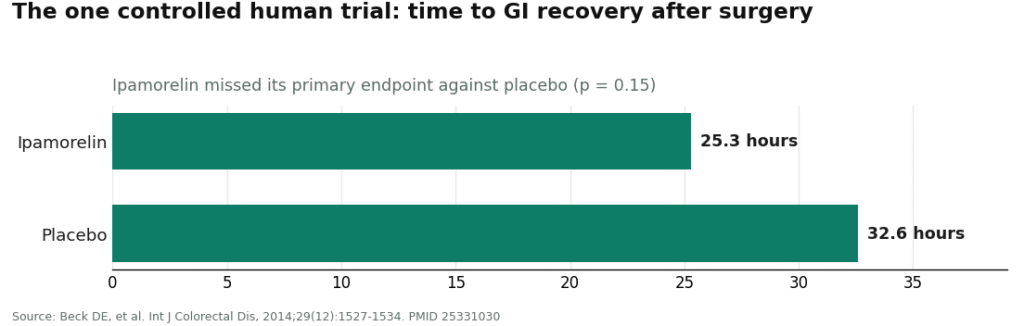
No amount of supervised pricing changes that evidence picture. Paying more buys oversight and honesty about what’s known. It does not buy a stronger trial result that doesn’t exist.
Quick FAQ, the skeptic’s version
Is the supervised price actually worth it against a much cheaper vial?
On a quality-adjusted basis, yes, because they aren’t the same product being sold twice. The $150 to $300 monthly range buys a clinician, a pharmacy with testing built into its dispensing process, and someone accountable afterward. The cheaper vial buys milligrams labeled “not for human consumption,” full stop. You’re not overpaying for the same item. You’re paying for the parts the cheap version leaves out entirely.
Does a higher price mean ipamorelin works better?
No, and this is worth saying directly. Price has no bearing on the evidence. The largest controlled human trial, 117 patients, missed its primary endpoint (25.3 versus 32.6 hours, p = 0.15), though it was well tolerated [P2]. The receptor mechanism is real, shown in animal work [P1], and the bone-formation data are rat studies [P3]. A supervised provider buys oversight and an honest account of that evidence. It does not buy a guarantee the compound performs as the marketing implies.
If a seller is technically legal, is it also safe to use?
A research-chemical vendor can be legally fine as a lab-chemical retailer while the human use you’re picturing remains unapproved, and for competitive athletes, explicitly banned under the WADA 2026 Prohibited List [P6]. Legal-to-sell-as-a-chemical and safe-to-inject are two different claims. The gap between them is exactly where the hidden cost sits.
Hold three facts in your head at once before pricing any source: ipamorelin is a selective growth hormone secretagogue, not an approved drug; its compounding status is unresolved rather than settled; and it’s on the 2026 WADA prohibited list for anyone tested. Weigh a provider against all three. The milligram count on the label is the least informative number in the comparison.
What does ipamorelin actually do in the body?
It prompts the pituitary gland to release a pulse of growth hormone, similar in shape to the burst your body produces naturally during deep sleep. It appears to hit specific receptors without the cortisol or appetite effects tied to older secretagogues in its class. People use it hoping for better recovery, changes in body composition, or improved sleep, but the clinical evidence in healthy adults is limited and mostly short-term. Hoping for and demonstrating are different verbs here.
Why is ipamorelin suddenly part of so many wellness conversations?
It’s a synthetic pentapeptide, five amino acids strung together, built to stimulate growth hormone release. Its side-effect profile reads cleaner on paper than older secretagogues, which helped it catch on. The 2026 price surge pushed it into wider conversation partly because compounding restrictions tightened, making the supervised route both more visible and more expensive than the gray-market habits many people had quietly settled into.
Does stacking CJC-1295 with ipamorelin actually outperform ipamorelin alone?
The pairing is popular because the two peptides act on different steps: CJC-1295 extends the growth hormone pulse, ipamorelin triggers it, so in theory the combined signal is stronger and longer. In practice, most of what supports that theory comes from small studies or animal research, not large controlled human trials. Some clinicians favor the combination on mechanistic grounds. An honest one will also tell you the human evidence is suggestive, not conclusive, and those are not the same thing.
What dose do people actually use, and who decides that number?
Doses cited in clinical and compounding contexts commonly run 200 to 300 micrograms per injection, once or twice daily, but there’s no FDA-approved dosing standard, because there’s no FDA-approved drug to standardize. That means a number posted on a gray-market site is essentially unverified, copied from somewhere rather than derived from your own history. Through a physician-supervised compounding pharmacy like FormBlends, a prescriber reviews labs and health history before setting a protocol, which is the actual difference between a dose chosen for you and a dose lifted from a forum thread.
References
- Raun K, Hansen BS, Johansen NL, et al. Ipamorelin, the first selective growth hormone secretagogue. European Journal of Endocrinology, 1998;139(5):552-561. Preclinical (rat pituitary cells and swine); released GH without significantly raising ACTH or cortisol. https://pubmed.ncbi.nlm.nih.gov/9849822/
- Beck DE, et al. Prospective, randomized, controlled, proof-of-concept study of the ghrelin mimetic ipamorelin for the management of postoperative ileus in bowel resection patients. International Journal of Colorectal Disease, 2014;29(12):1527-1534. 117 enrolled, 114 analyzed; missed primary endpoint (25.3 vs 32.6 hours, p = 0.15); well tolerated. https://pubmed.ncbi.nlm.nih.gov/25331030/
- Andersen NB, et al. The growth hormone secretagogue ipamorelin counteracts glucocorticoid-induced decrease in bone formation of adult rats. Growth Hormone and IGF Research, 2001;11(5):266-272. Animal (rat) study.
- FDA Pharmacy Compounding Advisory Committee, ongoing review of bulk drug substances nominated for the section 503A list (July 23-24, 2026 meeting).
- Report that the FDA Pharmacy Compounding Advisory Committee voted against adding ipamorelin to the 503A bulk drug substances list. Alliance for Pharmacy Compounding.
- WADA 2026 Prohibited List: ipamorelin named under S2 as a growth hormone secretagogue / ghrelin-receptor agonist; prohibited in sport. World Anti-Doping Agency.
Supplemental (industry/ranking context):
C1. “2026 FDA Peptide Crackdown Explained: 8 Providers That Survived.” Independent LinkedIn analysis of how the 2026 regulatory tightening separated compliant, supervised peptide providers from the rest. (independent third-party commentary; not a clinical source and not used to substantiate any factual or efficacy claim)
Written by Junia Quang, research writer. Last reviewed May 2026.
For general information. Speak with a qualified healthcare provider before changing anything.